
Author
Nahid Komol
Published
22 November, 2025
Human Written
In 2025, online shopping won't just be a channel—it will be a living, dynamic experience shaped by AI, immersive tech, and smarter infrastructure.
As of 2025, global eCommerce sales are projected to pass $6.86 trillion, making up about 21% of all retail purchases. At the same time, mobile commerce is rising sharply: it's expected to represent nearly 59% of total eCommerce sales.
These numbers show one thing: digital shopping is no longer optional. It's central.
In this article, you'll discover the 12 biggest eCommerce trends every business should watch. You'll get insight, real data, and practical steps to understand the future of eCommerce.
Let's get started.
The big picture: What's driving change in eCommerce
Several key shifts are pushing the eCommerce industry into a new phase. These changes aren't just technical; they reflect more profound shifts in how people shop, what they expect, and how businesses operate.
- AI everywhere: Artificial intelligence is now part of every step in online retail, from product discovery to post-purchase support. Modern stores use AI to understand customer intent, automate decisions, and predict demand with more accuracy.
- Higher customer expectations: Shoppers want faster, easier, and more personal experiences. They expect real-time answers, personalized offers, and instant checkout, all while keeping their data safe.
- Mobile dominance: With nearly 6 in 10 online purchases happening on phones, mobile-first design is no longer optional. A site that loads slowly or feels clunky on mobile loses conversions instantly.
- Sustainability and transparency: Today's buyers care about the environment and ethics. Many prefer brands that use recycled materials, offer carbon-neutral shipping, or share how products are made.
- Composable technology: Businesses are moving away from one-size-fits-all platforms to modular systems. Headless and API-driven setups make it easier to innovate and integrate new tools as markets evolve.
- Global accessibility: Cross-border shopping continues to grow as logistics, payments, and localization improve. Shoppers expect the same seamless experience whether they're in London, Dhaka, or Los Angeles.
- Changing platform models: The old approach of relying on all-in-one platforms is giving way to more flexible, API-first solutions. The need for scalability, customization, and integration with a growing stack of tools and services is driving this move toward headless commerce.
Trend 1: AI for personalization and predictive commerce
AI is now at the center of the future of eCommerce. In 2025, personalization goes beyond showing "recommended products." It's about understanding the context, behavior, and emotion behind every click.
Personalized experiences built on behavior and context
Modern AI models analyze browsing habits, purchase history, and even scrolling speed to predict what a shopper wants next. Instead of simple rules, machine learning adapts to each visitor in real time.
For example, if someone browses eco-friendly products often, AI can highlight similar sustainable options or suggest bundles that match that value.
Sentiment-driven experiences
One of the more advanced shifts in eCommerce technology trends is using AI to detect and respond to customer sentiment. This could include tone in live chats, product reviews, or even social media comments. Brands can use this data to adjust messaging, flag frustrated users, or suggest calming, confidence-boosting content when needed.
Predictive commerce in action
Predictive AI uses data patterns to forecast future demand and behavior. It helps brands plan inventory, pricing, and marketing in advance. Stores using predictive AI are seeing better stock control and fewer lost sales due to shortages.
What this means for businesses
- Turn every shopper interaction into actionable insight.
- Use emotion and context, not just clicks, to shape offers.
- Plan with data-backed forecasts instead of guesses.
Trend 2: Agentic and autonomous AI
While AI has traditionally been used to support human decision-making, a new phase is emerging: autonomous AI agents that act independently on behalf of the shopper. These systems don't just recommend — they decide.
What agentic AI means
AI agents are systems trained to perform complete shopping tasks without constant user input. A customer could assign preferences, budgets, or style preferences, and the AI would handle the rest from product discovery to checkout. This level of automation is already being tested in sectors like travel, grocery, and fashion, and it's expected to expand.
Why it matters in 2025
As digital convenience continues to evolve, some shoppers won't want to scroll, click, or compare. They'll prefer handing the task over to a trusted agent that understands their needs and can take action without friction.
This shift could impact everything from SEO to product listings and real-time pricing. It may also require brands to rethink how they structure data and how easily it can be parsed or interpreted by intelligent systems.
How businesses can prepare
- Optimize your product data for AI discovery (structured, clear, and accessible).
- Prepare APIs that allow AI systems to pull data, pricing, and inventory automatically.
- Focus on transparent reviews, shipping, and policies; these will influence AI-driven decisions.
Trend 3: Livestream and social commerce
Social media is no longer just a place for product discovery; it's become a direct shopping channel. According to Salesforce, social commerce sales are projected to hit nearly $2.9 trillion globally by 2026, up from $992 billion in 2022.
The rise of social shopping and livestream shopping
Customers now expect to shop without ever leaving their favorite apps. Platforms like Instagram, TikTok, and YouTube have all introduced built-in shopping features.
These include in-app product tagging, live event checkouts, and creator storefronts. Instead of directing users to a separate website, brands are meeting customers where they already scroll.
On the other hand, livestream shopping is where hosts demonstrate products in real time. It blends entertainment and urgency, often leading to higher engagement and conversion compared to traditional formats.
In China, livestream sales already make up about 40% of total eCommerce revenue, and Western markets are catching up fast.
The role of user-generated content and Influencers
Influencer marketing has shifted from sponsored posts to direct conversions. Shoppers are more likely to trust a product recommendation from a creator they follow than from an ad. This trust, combined with real-time interaction during live sessions, makes social commerce a powerful driver of sales and brand loyalty.
Short-form video content, tutorials, and behind-the-scenes clips are also becoming key parts of the digital shopping future, especially when they link directly to products that can be purchased instantly.
What this means for eCommerce brands
- Partner with creators who fit your niche instead of chasing big names.
- Focus on authenticity and live interaction over polished studio setups.
- Use social data to identify what products perform best in each platform's ecosystem.
Trend 4: Augmented reality (AR), VR, and immersive shopping
In 2025, eCommerce is becoming more visual and interactive. Shoppers don't just want to see a product; they want to experience it before buying. That's where AR and VR step in. These technologies are redefining the future of online shopping by closing the gap between digital and physical experiences.
Why immersive shopping matters
Photos and descriptions can only go so far. Shoppers want to know if a product fits their space, matches their style, or suits their needs. Virtual try-ons, 3D product models, and interactive room visualizers are helping bridge that gap. When customers can "see it in their room" or "try it on" virtually, they're more confident in their decision and less likely to return the item.
According to Shopify, products with AR content see up to 94% higher conversion rates than those without. This is especially important in categories like fashion, furniture, home decor, and cosmetics, where fit and aesthetics are a big part of the buying process.
VR for deeper engagement
While AR helps customers interact with products in their real environment, virtual reality takes it a step further by placing them inside a complete experience. Think of walking through a virtual store, attending a product launch event, or browsing curated collections in a 3D environment.
Some brands are experimenting with fully immersive stores where users can "walk" through digital aisles, pick products, and check out all within a headset or browser.
What this means for eCommerce businesses
- Start by offering AR previews for key product categories.
- Use 3D modeling tools to build interactive catalogs.
- Focus on product quality and detail visuals matter more than ever.
Trend 5: Omnichannel and unified commerce
Today's shoppers move between multiple touchpoints before making a purchase. They browse on mobile, ask questions on social media, compare products on desktop, and sometimes complete the purchase in-store. That's why omnichannel retail is more than a trend; it's becoming a requirement.
The shift to unified commerce
Omnichannel retail focuses on being present across platforms. Unified commerce takes it further. It means connecting all sales channels like online, offline, mobile, and third-party platforms into a single, consistent experience. It goes beyond selling in multiple places.
For example, if someone adds an item to their cart on mobile, they should see it on desktop later. If a product is out of stock online but available in a nearby store, that information should be accurate and visible during checkout.
How customer expectations are shaping this
A report from Salesforce shows that 79% of consumers expect consistent interactions across departments, and 55% have switched brands over disconnected experiences.
Customers today expect flexibility in how they shop and receive their orders. They want the freedom to buy online and pick up in-store, reserve items online and pay at the counter, purchase in-store and have products shipped home, and return items easily across any channel.
When these options work smoothly and consistently, they build trust and loyalty.
What this means for eCommerce businesses
- Use a single source of truth for product data and inventory.
- Connect customer service, POS, and online order systems.
- Analyze combined data from all sales channels to understand real customer behavior.
Trend 6: Frictionless and flexible payments
Checkout is one of the most critical moments in the customer journey. Even a slight delay or extra step can lead to a lost sale. That's why businesses are prioritizing frictionless payments, fast, flexible, and easy-to-use payment options that remove barriers and improve conversion rates.
How payment expectations are changing
Shoppers expect to pay using the method that's most convenient for them — whether it's a digital wallet (Apple Pay, Google Pay, PayPal, and Stripe Link), credit card, or buy now, pay later (BNPL) service. The goal is speed and flexibility. Long forms, surprise fees, or required account creation can all lead to cart abandonment.
BNPL continues to grow, especially among younger shoppers. It offers a way to split payments without traditional credit cards, which can increase average order value and lower resistance at checkout. Services like Klarna, Affirm, and Afterpay are more popular.
Invisible payments are also on the rise. These are systems where payment happens with minimal interaction, often in the background, creating a seamless experience that mirrors the convenience of services like Uber or Amazon's one-click checkout.
What this means for eCommerce businesses
- Offer multiple payment options that match your audience.
- Keep checkout within one page — fewer clicks lead to higher conversions.
- Ensure security and transparency to build customer confidence.
Trend 7: Subscription-based commerce
Subscriptions are no longer limited to streaming services or magazines. Now, subscription commerce continues to grow across product categories from personal care and pet supplies to food, fashion, and beyond.
Why subscriptions are growing
Shoppers value convenience. Instead of reordering every month, they prefer automated deliveries for items they already trust, from coffee and pet food to software and wellness products. It's also becoming more common to see hybrid models where one-time purchases can be turned into repeat orders through post-purchase incentives or discounts.
Research from UnivDatos shows that the global subscription eCommerce market is expected to reach $478.2 billion by 2025, growing at over 68% annually.
The advantages for businesses
- Predictable revenue: Subscriptions create stable, recurring income instead of one-time spikes.
- Higher retention: Members stay longer because they form habits around your product.
- Upsell potential: You can offer add-ons, loyalty tiers, or personalized bundles.
What this means for eCommerce businesses
- Focus on value and flexibility, let users pause or skip orders easily.
- Personalize plans using purchase data and AI-based predictions.
- Keep pricing transparent to build long-term trust.
Trend 8: Sustainability and ethical commerce
As customers become more aware of how their purchases affect the world, sustainable eCommerce is no longer optional; it's a key part of the future of eCommerce. Now, shoppers are actively choosing brands that care about the planet, fairness, and transparency. Businesses that ignore this shift risk losing trust and relevance.
What consumers expect
According to the Business Standard, 55% of global shoppers have paid more for sustainable products, and the number keeps rising. Buyers now look for details like eco-friendly packaging, fair labor sourcing, and carbon-neutral delivery options.
Green operations and circular models
eCommerce brands are reducing waste by adopting recyclable materials, minimal packaging, and digital receipts. Circular commerce, where products are reused, repaired, or resold, is also growing fast.
Some brands are also adding resale and refurbishment programs to extend the life of their products and reduce returns. This not only reduces environmental impact but also creates new revenue streams through trade-ins or refurbished items.
What this means for eCommerce businesses
- Switch to recyclable or biodegradable packaging.
- Offer options for second-hand or refurbished products.
- Share sustainability goals and results publicly to build trust.
Trend 9: Data privacy and security infrastructure
As eCommerce becomes more data-driven, privacy and trust are becoming core to business success. Shoppers now care not just about what they buy, but how their information is handled.
Why privacy matters now more than ever
People want control over their data. That means knowing what's being collected, how it's being used, and having the option to opt out. A recent Cisco study found that 92% of consumers believe organizations must be proactive about data protection, and over 80% say they would switch brands if privacy isn't respected.
At the same time, privacy regulations continue to expand with laws like GDPR, CCPA, and new country-specific rules requiring stricter data handling practices. For businesses, this creates a balance to manage: delivering a personalized shopping experience while respecting user privacy.
Not only that, businesses are now shifting toward first-party data, which provides insights directly from customer interactions. This approach allows for personalization without relying on third-party tracking.
Key elements of modern data protection
- First-party data: Relying less on third-party cookies and more on data collected directly from your own site, with clear consent
- Privacy-by-design: Building systems that protect customer data from the ground up
- Consent management: Giving users clear choices about tracking, communication, and data use
- Zero-trust security models: Treating every interaction as a potential risk and validating every access request
What this means for eCommerce businesses
- Be transparent about what data you collect and why.
- Replace third-party cookies with consent-based tracking tools.
- Train staff on data handling and privacy compliance.
- Regularly test systems to prevent vulnerabilities.
Trend 10: Logistics and supply chain innovation
Now, fast and flexible delivery is no longer a competitive edge; it's a baseline expectation. The real differentiator is how businesses manage logistics behind the scenes. As customer demands increase and supply chains become more complex, innovation in this area is becoming a priority.
Shoppers now expect same-day or next-day delivery, flexible return policies, and accurate delivery windows. At the same time, they want more visibility into where their orders are and how they're handled, especially when buying from smaller or independent brands.
To meet these expectations, businesses are investing in:
- Micro-fulfillment centers in urban areas
- Real-time inventory tracking
- Automated picking and packing
- More innovative return processes that reduce waste and costs
Some brands are also exploring in-house fulfillment models to gain more control over operations and reduce reliance on third-party carriers.
The role of technology in modern logistics
Logistics is no longer just about shipping. It's about coordinating systems that manage inventory, warehouses, delivery partners, and customer communication all in real time. Automation and AI are increasingly used to improve routing, forecast demand, and prevent stockouts.
This is especially important for omnichannel businesses, where online and in-store inventory need to stay in sync.
What this means for eCommerce businesses
- Use real-time inventory syncing to avoid overselling.
- Partner with local delivery networks for faster fulfillment.
- Track logistics KPIs like delivery time, order accuracy, and return rates.
Common challenges and risks to watch out for
While the opportunities in eCommerce are growing, it also comes with new challenges. Many businesses rush to adopt the latest eCommerce technology trends without proper planning. This often leads to wasted time, cost, and confusion.
Here are the main risks to keep in mind.
- Over-reliance on "shiny tech": It's easy to get caught up in trends like AI or AR without a clear goal. Tools should solve a specific problem — not just look impressive. Always test new technology with a pilot project before scaling.
- Fragmented tech stacks: Using too many disconnected tools often creates data silos and workflow issues. This slows down decisions and makes personalization harder. Moving toward headless commerce or modular systems helps keep operations consistent.
- Rising costs: Advertising, logistics, and software expenses are increasing. Without careful budget tracking, profit margins can shrink quickly. Automate processes where possible, and focus marketing spend on high-performing channels.
- Regulatory shifts: Data protection and tax laws are changing globally. Brands selling across borders must stay compliant with regional rules to avoid penalties or restrictions.
- Customer trust erosion: Inconsistent experiences, unclear policies, or slow support can damage brand reputation fast. Maintaining transparency and responsive service is key to keeping customers loyal.
How eCommerce businesses can prepare (expert tips)
The future of eCommerce belongs to companies that move fast but plan smart. You don't need to follow every new trend; you need to choose the ones that make sense for your brand, customers, and resources.
Here's how to prepare for 2025 and beyond.
- Assess readiness: Start with a full audit of your current setup, technology, data, and people. Identify what's outdated, what can be automated, and where customer experience needs improvement. Use analytics tools to find where users drop off or face friction.
- Start small and test: Don't try to adopt everything at once. Pick one trend that fits your audience, such as AR previews, AI-driven personalization, or subscription models. Test it, track results, and expand only when it proves value.
- Build strong partnerships: Work with vendors and agencies that understand your business goals. The right technology partner can help integrate tools faster, ensure security, and optimize your entire commerce flow.
- Measure what matters: Define your success metrics early. Track KPIs like customer lifetime value (CLV), conversion rate, and return rate. Regular performance reviews help you understand what's working and where to adjust.
- Keep iterating: Digital commerce isn't static. What works today may need to evolve next quarter. Build feedback loops into your processes so you can adjust quickly. When something works, invest in scaling it.
Good news: ZOYEQ is built for 2025 and beyond
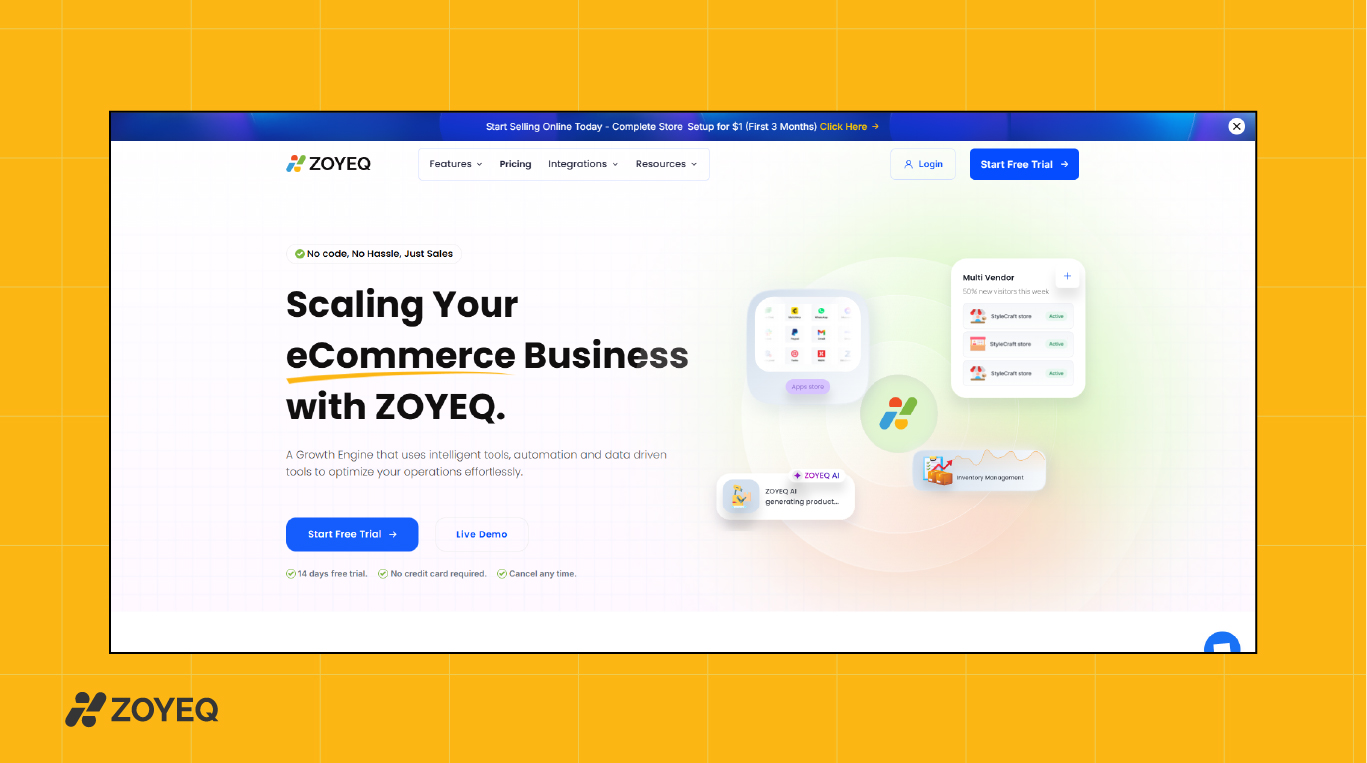
As the eCommerce world evolves, most platforms are still trying to catch up with new technologies. ZOYEQ, however, was built with the future of eCommerce in mind from day one. It's not just another store builder; it's a complete SaaS platform designed to help businesses scale with speed, automation, and flexibility.
Designed for modern growth
ZOYEQ uses an API-first, modular architecture, meaning every part of your store, checkout, payments, products, or design can adapt as your business grows. You can integrate new tools, update storefronts, or connect marketing apps without breaking your existing setup.
Built for smarter selling
With built-in AI-powered tools, ZOYEQ helps generate product pages, automate content, and personalize recommendations for each visitor. This ensures faster setup and better engagement, key to staying ahead in the digital shopping future.
Fast, scalable, and reliable
ZOYEQ runs on optimized infrastructure for speed and uptime. Whether you're running one small store or a large multi-vendor marketplace, it delivers consistent performance and smooth operations.
Integration-ready
ZOYEQ connects with major payment gateways, shipping providers, and marketing tools, all managed from one dashboard. From PayPal and Stripe to Google Analytics and Facebook Pixel, integrations work out of the box so you can focus on growth.
👉 Explore ZOYEQ and See How It Can Power Your Growth in 2025
Join over 100+ brands already using ZOYEQ to grow their eCommerce business. Enjoy 70% faster setup time compared to traditional systems and experience a 4.8 average user rating for performance, speed, and ease of use.
Get Started with ZOYEQ →Conclusion
The future of eCommerce is already here. By 2025, growth will depend on how fast brands can adapt not just to new tools, but to changing customer expectations.
The key is focus. You don't need to adopt every trend at once. Start small, test what works, and build systems that can evolve over time. The most successful online stores in 2025 will be those that are flexible, data-driven, and human-centered.
That's where ZOYEQ stands out. It's built for the next generation of online businesses, scalable, API-ready, and designed to help you deliver fast, personalized, and secure shopping experiences.
If you're planning your next move, now is the right time to future-proof your business.
FAQs
What trends will matter in developing markets?
Mobile-first commerce, social shopping, and flexible payment options tend to take priority in developing regions. Lower infrastructure costs and high mobile usage make these areas fast adopters of lightweight, scalable solutions.
Which trend should small merchants pick first?
Start with AI-driven personalization or social commerce. Both can be implemented quickly and deliver visible results, better engagement, higher conversions, and repeat buyers without large budgets or complex setups.
Is headless only for large brands?
No. While headless commerce started with enterprise solutions, many modern SaaS platforms like ZOYEQ make it accessible for small and mid-sized businesses. It allows flexibility without heavy development costs.
What if I can't build all trends at once?
You don't need to. The best approach is to prioritize one or two trends that align with your business goals, test them, and expand from there. Focus on value, not volume.